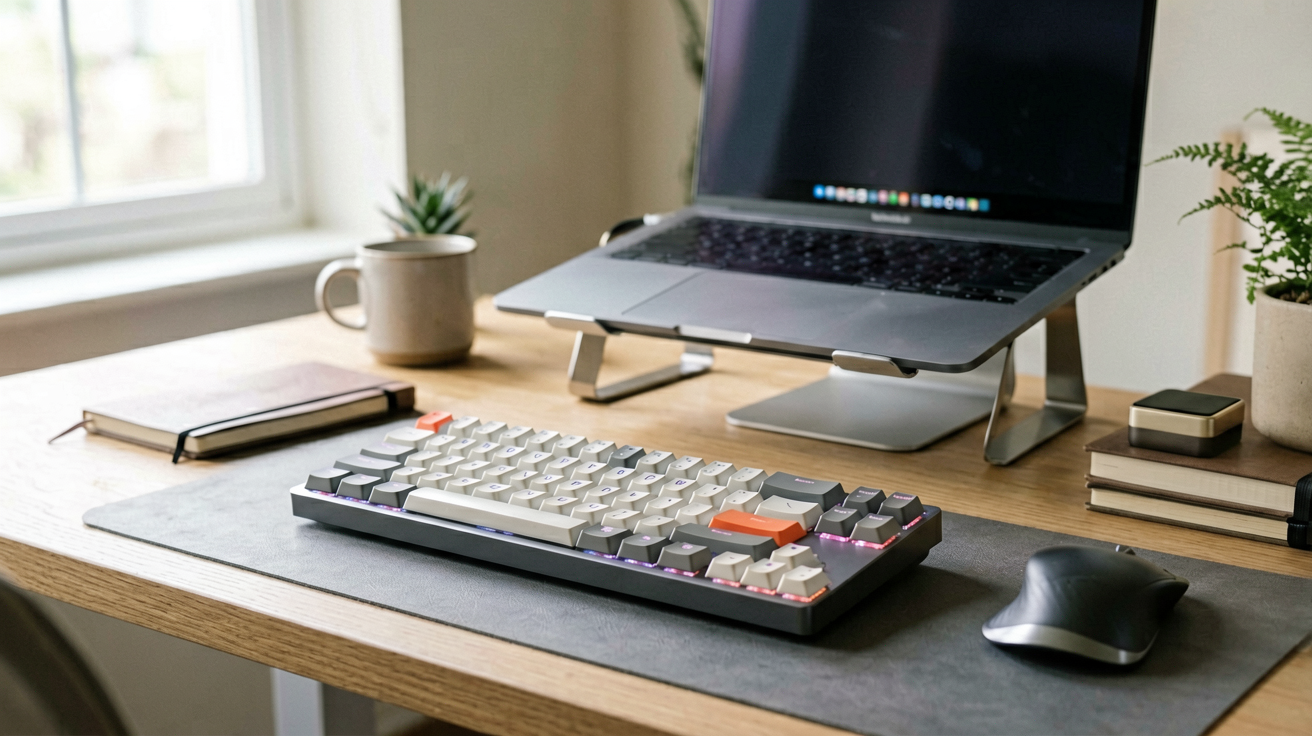
Best Mechanical Keyboard for Coding in 2026
A mechanical keyboard changes how coding feels for eight hours a day. These are the picks that hold up for programmers, with real prices and ratings as of August 2026.
Quick Verdict: The best mechanical keyboard for coding in 2026 is the Keychron C2 at $60.79 with a 4.5 star rating from 171 ratings on Amazon. It gives you a full layout, Gateron G Pro Red linear switches, and hot-swap sockets at a price that beats most brand-name gaming boards. If your desk is small, the RK Royal Kludge RK61 at $39.99 with 4.6 stars is the compact pick that keeps the key programming features.
FTC Disclosure: ShoppingShare participates in the Amazon Associates program and the Skimlinks network. We may earn a commission on qualifying purchases made through the links below, at no extra cost to you. This does not influence our assessment.
Related Guides
- Best Wireless Keyboards Under $30 (2026)
- Logitech MX Keys S vs Wave Keys: Which to Buy
- Logitech MK270 Wireless Combo Review 2026
Why Your Keyboard Matters More Than Your Monitor
I spent three years coding on a laptop keyboard before I admitted the problem. My wrists ached by Thursday, my typing speed dropped in the afternoon, and I kept hitting the wrong keys during late night pushes. The monitor upgrade got all the attention. The keyboard quietly cost me more fatigue than any other piece of gear on my desk.
A mechanical keyboard fixes the two things that actually matter for typing all day. First, the switch gives you a physical response at the exact moment a key registers. You stop bottoming out and start typing with a lighter touch. Second, you choose the switch weight and feel. That control does not exist on a membrane board.
Keyboard layout research has documented this for decades. The physical arrangement of keys affects speed and error rate, and your choice of switch affects how much force your fingers need per keystroke. Multiply that by the 20,000 to 50,000 keystrokes a typical developer types in a day and the difference shows up fast.
What to Look For in a Coding Keyboard
Here is the short version of what matters when you shop in 2026:
- Hot-swappable switches. The single most future-proof feature. You can change switch feel in minutes without soldering.
- Wired connection. Bluetooth adds latency and battery anxiety. A USB cable is instant and never dies mid-sprint.
- Full key rollover. Most modern boards have it. It registers simultaneous keypresses correctly, which matters for shortcuts like Ctrl+Shift+K.
- Programmable keys. Layers and macros turn repetitive actions into single keystrokes.
- A layout that fits your desk. Full size, tenkeyless, and 60 percent all have tradeoffs, and only you know your space.
Is a Full Size or Compact Keyboard Better for Programmers?
Full size wins for most people who code all day. You get F keys for debugging tools, arrows for navigation, and a numpad if you touch numbers regularly. The RK61-style 60 percent layout saves space but you pay for it in layers. I hit the F5 key constantly in my own workflow, so a board that hides it behind a function layer slows me down.
The compromise most programmers land on is a tenkeyless or a 75 percent layout. You keep the F row and arrows, drop the numpad, and save a chunk of desk. The Keychron C2 in this guide sits close to full size without taking the full width, which is why it leads the list.
The Best Mechanical Keyboards for Coding in 2026
Keychron C2 Full Size Wired Mechanical Keyboard
$60.79 on Amazon (as of August 10, 2026) | 4.5 out of 5 stars from 171 ratings
The Keychron C2 is the board I point coders to first. It is a full size layout with Gateron G Pro Red switches, which are linear and smooth, and every switch sits in a hot-swap socket. You can change to browns or blues later without buying a new keyboard.
Keychron designed this board for Mac and Windows, which matters more than people expect. The keycaps include both legends and the top row works as media controls on a Mac out of the box. The USB-C connection is wired only, and that is a feature for programmers, not a gap. No pairing, no battery, no input lag.
Who should buy this and why now: you type eight hours a day, you want a full layout with the F row and arrows always visible, and you want to try different switches over the next two years without buying new boards. At $60.79 it undercuts most full size hot-swap options, and the linear red switches are the standard recommendation for long typing sessions. This is the safest first mechanical keyboard for a developer.
Check current price on Amazon →
RK Royal Kludge RK61 Wired 60 Percent Mechanical Keyboard
$39.99 on Amazon (as of August 10, 2026) | 4.6 out of 5 stars from 6,524 ratings
The RK61 proves you do not need a big desk for a serious board. It is a 60 percent layout with a compact footprint, and it still carries a 4.6 star rating from more than six thousand five hundred buyers, which says a lot for a budget keyboard.
What makes it interesting for coders is the programmability. This version works with QMK-style remapping and VIA software, so you can assign layers, macros, and shortcuts and store them on the keyboard itself. The switches are hot-swappable here too, at a price point where that feature almost never appears.
The tradeoff is real. The F row, arrows, and navigation cluster live behind layers. If your workflow depends on F5, Home, End, and arrow keys, expect a week of retraining your muscle memory. I would not recommend it as the only board for a full stack developer who touches numbers and debuggers constantly.
Who should buy this and why now: you work from a coffee shop, a small apartment desk, or you travel with a laptop and want a keyboard that fits in a backpack. You also want the coding essentials, hot-swap sockets and programmable layers, for under $40. This is the best value compact board on this list.
Check current price on Amazon →
Redragon Mechanical Gaming Keyboard with Hot-Swappable Red Switches
$29.99 on Amazon (as of August 10, 2026) | 4.3 out of 5 stars from 6,725 ratings
The Redragon is the budget pick that still gives you hot-swappable switches and a wired connection. It is marketed as a gaming keyboard, but the red linear switches and full key rollover translate directly into a decent typing board for the price of two pizzas.
It has eleven backlit modes, which you can ignore, and the build quality is plastic but solid. The selling point for a coder on a budget is simple. You get a real mechanical switch under every key, a standard layout you can replace keycaps on, and hot-swap sockets so your first upgrade is a switch set instead of a new board.
Where it falls short: the board is loud relative to the Keychron, the included keycaps are average, and there is no software for remapping beyond basic lighting. For pure typing work it is completely fine. For a pro workflow with macros and layers, the other two options in this guide do more.
Who should buy this and why now: you want your first mechanical keyboard for under $30, you game and code on the same desk, and you want to keep the option of swapping switches later. It is the perfect starter board before you commit to a higher budget.
Check current price on Amazon →
How They Compare
| Keyboard | Price (Aug 10, 2026) | Rating | Layout | Hot-swap | Best for |
|---|---|---|---|---|---|
| Keychron C2 | $60.79 | 4.5 (171) | Full size | Yes | Daily full time coding |
| RK Royal Kludge RK61 | $39.99 | 4.6 (6,524) | 60 percent | Yes | Small desks and travel |
| Redragon | $29.99 | 4.3 (6,725) | Full size | Yes | First board on a budget |
Prices and ratings were captured from Amazon product pages on August 10, 2026. They change often, so treat them as a snapshot, not a promise.
My Pick After All This
If you only read one paragraph, read this. The Keychron C2 is the right choice for the majority of programmers because it combines a full layout, linear switches, and hot-swap sockets at a price that makes the decision easy. The RK61 is the right choice if desk space is the constraint. The Redragon is the right choice if $30 is the ceiling. All three are wired, all three are hot-swappable, and all three have real ratings from real buyers.
How to Set Up a New Keyboard for Coding
- Update the firmware if the manufacturer offers a tool. Check the product support page first.
- Remap the caps lock key. Most programmers turn it into Ctrl, Escape, or a layer key.
- Set your keyboard layout in the OS to match the physical layout you bought.
- Try the board for a week before ordering new switches. Your first feel guess is often wrong.
- Keep the switch puller and a spare switch set nearby for the day you want to experiment.
Buying Guide (based on published specs)
Switch types: Linear switches (red) move straight down and are the quietest and lightest. Tactile (brown) give a small bump at actuation. Clicky (blue) add an audible click and are best avoided in shared offices. All three are available for these boards, and hot-swap sockets let you switch between them.
Key rollover and polling: Full key rollover means every keypress registers even when you hold many at once. Wired boards poll at up to 1000 Hz on most modern models, which is effectively instant for typing and shortcuts.
Keycaps: Double-shot PBT keycaps last longer and resist the shiny wear that ABS caps develop. Budget boards ship with ABS more often. Replacing keycaps is a budget friendly upgrade that changes the feel of a board you already like.
Internal Picks
- Looking for a ready shortlist? See our Mother's Day Gifts
- Looking for a ready shortlist? See our Valentine's Gifts
FAQ
Is a mechanical keyboard worth it for coding?
For anyone who types more than a few hours a day, yes. The tactile feedback and consistent actuation reduce typos and finger fatigue over a full workday. You can also swap switches on hot-swappable models instead of buying a new board when you want a different feel.
Which switch is best for programming?
Most programmers prefer linear switches for long typing sessions because they need less force and produce no bump or click. Red switches are linear and quiet enough for shared offices. Tactile switches like browns give feedback without noise if you want confirmation on every keystroke without annoying coworkers.
Do I need a hot-swappable keyboard?
Not strictly, but it is the feature programmers end up glad they paid for. Hot-swap sockets let you pull a switch out with a small tool and install a new one in seconds. That means you can try heavy springs, clicky switches, or silent linears without soldering or buying a second keyboard.
Should I get a 60 percent or full size keyboard for coding?
It depends on desk space and what you do besides typing. A 60 percent board saves a lot of desk real estate but hides the F keys and arrows behind layers. Full size gives you arrows, F keys, and a numpad ready at all times. Many programmers pick a tenkeyless or 75 percent layout as the middle ground.
Reference
We may earn commissions from Amazon and Skimlinks partner merchants (affiliate links, supports the site).
ShoppingShare participates in the Amazon Associates Program. We may earn commissions from qualifying purchases at no extra cost to you. Our reviews are based on independent analysis of user reviews and product specifications.
More Reviews & Guides
View all →

Found Something You Like?
All prices on Amazon may change. Check the current deal before it's gone.
More Amazon Deals →