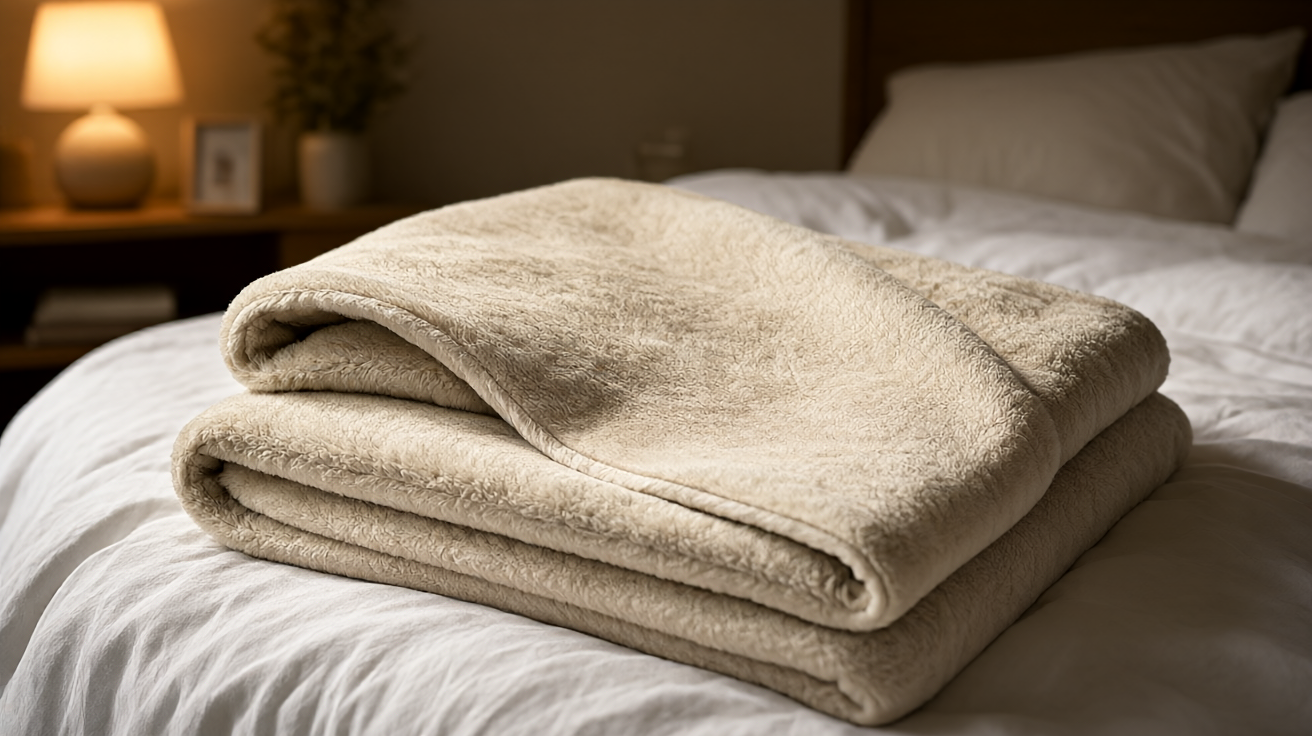
Best Heated Blankets for Safe Warmth in 2026: Labels, Wattage, and Who Should Skip One
A safety-first heated blanket guide built on UL 964, NFPA fire data, and published medical guidance. What the label means, real wattage and running cost, and who should not use an electric blanket at all.
Best Heated Blankets for Safe Warmth in 2026: Labels, Wattage, and Who Should Skip One
A heated blanket is one of the most affordable ways to sleep warm in a cold bedroom. It is also one of the few comfort gadgets that carries a real burn and fire warning, which is exactly why the label matters more than the price tag.
This guide is deliberately not a ranked list of specific models. We do not run a physical testing bench, and we cannot verify live Amazon listings reliably from our end. Instead, we compiled the safety standard, the fire data, and the medical guidance that apply to any heated blanket you are considering, so you can judge a listing on its own merits.
TL;DR: Look for third-party certification to UL 964, the standard for electrically heated bedding. Pre-warm the bed for 20 to 30 minutes, then switch the blanket off and unplug it before you sleep. Expect roughly 50 W for a throw and 80-200 W for a queen or king, costing about 14 cents for eight hours at 100 W and the US average electricity rate. Do not use one overnight if you have diabetes with neuropathy, reduced skin sensation, or cannot reliably move away from heat.
1. What the Certification Label Actually Means
The relevant safety standard in North America is UL 964, Electrically Heated Bedding. Its stated scope covers electrically heated blankets, comforters, quilts, sheets, mattress pads, mattresses, foot warmers, throw blankets, and similar bedding. Products under the standard are cord-connected, run on a nominal 120 V supply, and ship with a switch or one or two user-adjustable temperature-control units. They may be thermostatically controlled.
Two details worth knowing:
- Edition 12 is the active revision, and a supplement published on September 18, 2020 added requirements for remotely operated, smart-enabled bedding. A connected blanket that can be controlled from a phone app is therefore inside the standard's scope, not outside it.
- Certification is per product, not per brand. A logo on the packaging means a representative sample was tested to the standard. If a listing shows no recognized certification mark at all, treat the blanket as unverified regardless of how many reviews it has.
UL Solutions also notes that the Consumer Product Safety Commission has recalled many electric blankets from various manufacturers after cases of minor burns, and recommends buying only blankets approved by a nationally recognized testing agency.
2. Two Habits That Prevent Almost Every Incident
The fire and burn data points to a short list of recurring causes rather than mysterious product failures. The Maine State Fire Marshal's office summarizes the practical rules:
- Pre-warm, then switch off. Use the blanket to heat the bed before you get in, then turn it off and unplug it once you are in bed. People with diabetes are specifically advised not to sleep with an electric blanket on at all.
- Never stack heat layers. Do not put ordinary blankets or bedding on top of an electric blanket, and do not use an electric blanket and a heating pad at the same time. Trapped heat is the mechanism behind contact burns.
- Protect the cord. Never route the cord between the mattress and box spring, and keep it from being pinched by frames, slats, or footboards. A damaged conductor is the part most likely to fail with age.
- Inspect before each season. Cracked insulation, frayed plugs, scorch marks, or a controller that behaves erratically mean retire the unit. Older blankets, particularly those over ten years old, are repeatedly identified as the higher-risk group.
A heating pad deserves a separate rule: it concentrates heat on a small area pressed against skin. Published guidance is to use it on low with a fabric layer between pad and skin, for the limited window stated on the packaging (typically no more than 15 to 20 minutes at a time), and never to fall asleep with it on.
3. What the Fire Data Says
The National Fire Protection Association reports that heating equipment is a leading cause of home fire deaths in the United States. From 2020 through 2024 annual averages, fire departments responded to an estimated 37,365 fires involving heating equipment per year, about 11 percent of all reported home fires, resulting in 417 civilian deaths, 1,260 civilian injuries, and 1.2 billion dollars in direct property damage. Nearly half of those fires, 46 percent, occurred in the three months from December through February, which is also when heated blankets come out of storage.
That is the broad picture. The specific picture for electric bedding is much smaller. NFPA's Home Structure Fires supporting tables, using 2019-2023 estimated annual averages, list "Blanket - electric" as involved in ignition in 57 reported home fires per year, with 0 civilian deaths, 4 civilian injuries, and about 3 million dollars in direct property damage. For comparison, the same table lists heating pads at 77 fires, 3 deaths, and 4 injuries.
Put together: an electric blanket is a small share of heating-equipment fires, and the fatalities in the data are associated with heating pads and other equipment rather than blankets. The number that should shape your behaviour is not 57 fires a year. It is zero, because the exposure is almost entirely determined by age, cord condition, and whether the blanket is left on overnight.
4. Wattage and Running Cost
Wattage is the specification people skip and the one that explains both the comfort and the cost.
Published manufacturer ratings generally fall in these ranges:
| Type | Typical rated draw |
|---|---|
| Heated throw | 50-120 W |
| Twin / single blanket | 40-80 W |
| Full / queen blanket | 80-150 W |
| King / dual-zone blanket | 100-200 W |
Treat these as nameplate ranges to check on the controller or plug, not as measurements from our bench.
The arithmetic is simple: watts divided by 1,000, multiplied by hours, gives kilowatt-hours. At the US Energy Information Administration's 2026 residential average of about 18.2 cents per kWh:
- A 100 W blanket for one hour: 0.1 kWh, about 2 cents.
- A 100 W blanket for eight hours: 0.8 kWh, about 14 to 15 cents.
- A 200 W king-size blanket for eight hours on high: 1.6 kWh, about 29 cents.
For context, a plug-in electric space heater is typically rated near 1,500 W, so even a large heated blanket draws a small fraction of a heater's load. The cheaper strategy is not a lower-wattage blanket though. It is pre-warming for 20 to 30 minutes and switching the unit off, which costs a few cents per night.
5. Who Should Not Use One
This is the section that gets skipped in most buying guides and it is the reason this guide exists.
Published medical guidance consistently flags the following groups as higher risk for contact burns from electric bedding and heating pads:
- People with diabetes, especially with peripheral neuropathy. Nerve damage blunts heat sensation, so skin can burn before the person reacts. The NIDDK specifically advises people with diabetes not to place a hot water bottle or heating pad on their feet.
- Anyone with reduced skin sensation, including people with certain circulation or nerve conditions.
- Infants and young children, who cannot communicate discomfort or move away.
- Older adults, whose skin is thinner and heals more slowly.
- Pregnant people, who are commonly advised to avoid electric blankets.
- Anyone asleep, sedated, or unable to move away from the heat source. Time plus steady contact is what turns a warm surface into a burn.
The safer alternative for everyone in this list is the pre-warm method: heat the bed, switch the blanket off, unplug it, and use ordinary bedding for the night. A blanket that concentrates heat on the feet, such as a foot-warmer style pad, carries the same caution as a heating pad rather than the lower exposure of a whole-bed blanket.
If a burn does occur, current American Heart Association and American Red Cross first-aid guidance is to cool it with clean running water at 15 to 25 degrees Celsius for 5 to 20 minutes. Anyone with diabetes or reduced sensation should seek medical attention promptly, even for a mark that looks minor.
6. What to Look For When You Shop
Use this checklist against any listing. None of it requires a physical test bench, and all of it is verifiable from the product page or the manual.
- Third-party certification mark, typically UL or ETL, referencing electrically heated bedding. No mark, no purchase.
- Overheat protection and an automatic shut-off timer. Many modern controllers offer a timed shutdown; confirm it exists rather than assuming it.
- A controller with clear temperature steps, and dual controllers if the blanket is for a double, queen, or king bed and two people run at different warmth preferences.
- Detachable controller and machine-washable fabric, so the textile can be cleaned without immersing the electronics.
- A cord and plug in good condition with no sharp bends at the strain relief. Ask about cord condition before buying second-hand.
- An age limit you actually follow. If the blanket is more than ten years old, replace it rather than repairing it.
- Honest voltage compatibility. 12 V travel blankets designed for vehicle use behave differently from 120 V household blankets; do not assume an adapter makes them interchangeable.
- A reachable manual with the safety warnings. Manufacturers whose manuals are hard to find tend to be the ones whose listings skip the certification discussion too.
7. Who This Guide Is Not For
- If you want a ranked list of specific models with today's prices, this is not that page. We intentionally did not publish one, because a ranking without verified live listings would be a guess dressed up as a recommendation.
- If you are shopping on price alone, the safety checklist above will not help you. A cheaper uncertified blanket is the single highest-risk purchase in this category.
- If you want a heating solution for a whole room, a blanket is personal warmth, not room heating. NFPA's heating-equipment fire data is dominated by space heaters, which are a different product with a different risk profile and their own certification requirements.
8. Common Questions
Q: Is it safe to sleep with an electric blanket on? A: The safety guidance is consistent: pre-warm the bed, then switch the blanket off before you fall asleep. Overnight use is the exposure most often linked to burns, particularly for anyone who cannot feel heat well or move away. UL Solutions attributes the recommendation to burn specialists, and fire marshals repeat it in consumer guidance.
Q: How old is too old for an electric blanket? A: Fire safety guidance repeatedly singles out blankets more than ten years old as the higher-risk group. Heating elements and insulation degrade, and older controllers lack the overheat protection now expected under UL 964. Replace rather than repair.
Q: Can I use an electric blanket with a heating pad at the same time? A: No. Official guidance warns against combining them, because heat becomes trapped in the bedding layers. Use one or the other, and keep a fabric layer between any heating pad and your skin.
Q: Are smart or app-controlled heated blankets riskier? A: They are covered by the standard, not exempt from it. UL 964 gained a supplement in September 2020 specifically for remotely operated, smart-enabled bedding. The risk is unchanged by the control method; certification and correct use are what matter.
Q: What should I do if the blanket smells like burning or the controller feels hot? A: Stop using it immediately and unplug it. A scorched smell, discoloration, or a controller running noticeably hot are failure signals, not something to monitor. Retire the unit.
Sources
- NFPA, Home Heating Safety — 2020-2024 annual averages for heating-equipment fires, deaths, injuries, property damage, and the December-February share.
- NFPA, Home Structure Fires Supporting Tables (August 2025) — Table 27, 2019-2023 estimated annual averages: "Blanket - electric" 57 fires / 0 deaths / 4 injuries / $3M; "Heating pad" 77 fires / 3 deaths / 4 injuries / $4M.
- UL Standards, UL 964 Electrically Heated Bedding — scope, voltage, control requirements, active edition, and the 2020 remotely operated bedding supplement.
- UL Solutions, Electric Blankets Are Cozy, But Are They Safe? — certification, recalls, pre-warm guidance, and control features.
- Maine State Fire Marshal, Guidelines for Using Electric Blankets Safely — stacking, simultaneous use, and diabetes guidance.
- Medical News Today, Are electric blankets safe? — contraindications for diabetes, circulation issues, pregnancy, and children.
- US Energy Information Administration — residential electricity price used for the running-cost arithmetic.
Related Guides
- Best White Noise Machines for Sleep Under $30
- Best Heated Neck Massagers Under $40
- Best Heated Eye Masks for Dry Eyes
- Mini Dehumidifier for a Damp Rental Closet
FTC Disclosure: ShoppingShare participates in the Amazon Associates program and the Skimlinks network. We may earn a commission on qualifying purchases made through links on this site, at no extra cost to you. This guide is safety-reference content built from published standards, public fire data, and medical guidance. We did not test the products discussed, and no specific model is ranked or recommended. Prices, certifications, and availability change; verify the certification mark on the product you buy.
ShoppingShare participates in the Amazon Associates Program. We may earn commissions from qualifying purchases at no extra cost to you. Our reviews are based on independent analysis of user reviews and product specifications.
More Reviews & Guides
View all →

Ready to Grab Your Pick?
Prices shift daily on Amazon — click through to lock in today's deal before it's gone.
More Amazon Deals →