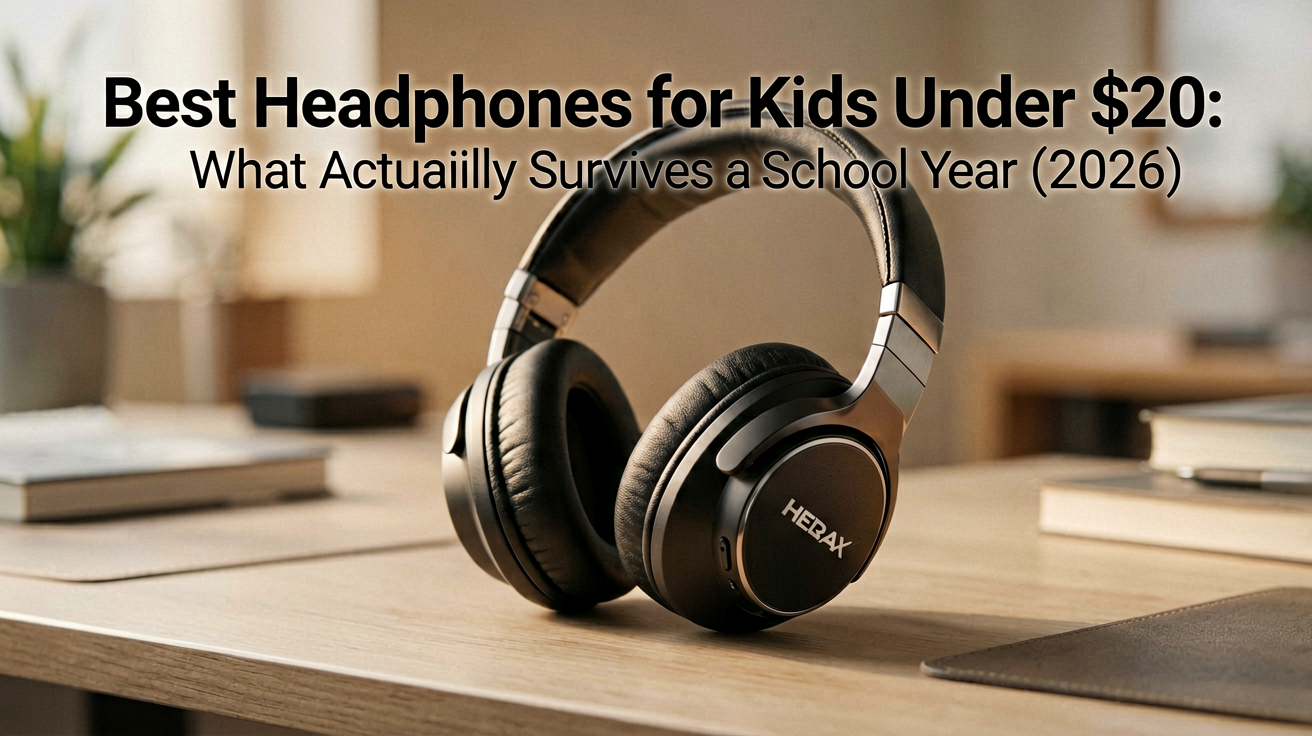
Best Headphones for Kids Under $20: What Actually Survives a School Year (2026)
Four volume-limited kid headphones under $20 with real Amazon prices and ratings, plus the honest downsides. Picked for classroom use, bus rides, and messy backpacks.
Best Headphones for Kids Under $20: What Actually Survives a School Year
Quick answer: for most elementary classrooms the iClever HS19 at $9.99 (4.6 stars) is the pick, because it pairs a volume limit with a cable that is not the usual thin rubber noodle. If your child needs a microphone for reading apps or remote sessions, the Botesty wired set at $12.99 (4.4 stars) covers that for three dollars more.
I have replaced more kid headphones than I want to admit. The pattern is always the same. A pair arrives, it works beautifully for six weeks, then one channel goes quiet and a small person insists they did nothing. Nobody did anything. The cable simply gave up where it enters the left earcup, which is where nearly all of them give up.
So this list is not about sound quality in any audiophile sense. Under twenty dollars, the drivers are all roughly the same. What separates these picks is the volume cap, the cable, and whether the headband survives being sat on.
All prices and ratings below were pulled from Amazon US on August 1, 2026. They move, so check the live page before you buy.
What actually matters at this price?
Three things, in order. First, a stated volume limit, because a child holding a tablet six inches from their face will absolutely max the slider. Second, cable construction, since that is the part that fails. Third, whether the headband adjusts far enough to still fit next year, because a pair outgrown in March is the same as a pair broken in March.
Everything else on the listing page is marketing. Padding thickness, color choice, and the word "premium" tell you nothing at this budget.
1. iClever HS19 : the safe default at ten dollars
$9.99 · 4.6 stars on Amazon US
This is the one I hand to people who ask without wanting a long conversation. It is an over-ear school design with volume limiting, a foldable frame, and a food-grade silicone headband that shrugs off the treatment a backpack gives it. At 4.6 stars it holds the highest rating of anything in this roundup, which at ten dollars is unusual.
Who should buy it: a parent of a kindergarten through fourth grade student who needs a pair for classroom listening stations this month and does not want to think about it again until spring.
Who it is not for: anyone who needs a boom microphone. The HS19 is playback only. If reading software or speech practice requires a mic, skip to the Botesty below.
👉 Check the iClever HS19 on Amazon
2. Botesty wired headphones with microphone : for reading apps and video calls
$12.99 · 4.4 stars on Amazon US
The addition here is the inline microphone, and that matters more than parents expect. A growing share of elementary reading and language programs listen to the child read aloud and score fluency. A tablet's built in mic picks up the whole room. A headset mic picks up the child.
It is also wired, which is the right call for a shared school device. Nothing to charge, nothing to pair, and no chance of the class connecting to the wrong tablet.
Who should buy it: families whose school uses a read-aloud or speech app, or anyone whose kid joins a weekly video tutoring session.
Who it is not for: kids who chew cables. The mic sits inline on the cord, and that section takes the abuse. If you have a cable chewer, the iClever with a shorter cord is the safer buy.
👉 Check the Botesty wired headphones on Amazon
3. Candy Bila kids headphones : the comfort pick for longer sessions
$14.55 · 4.6 stars on Amazon US
The most common complaint on cheap kid headphones is not sound, it is pressure. Small heads get squeezed by frames designed to fit a range, and after forty minutes the child takes them off and stops doing the thing you bought them for. This pair rates 4.6 stars with comfort mentioned repeatedly, and the over-ear cups sit around the ear instead of pressing on it.
Fifteen dollars is the top of what I would spend on an elementary school pair. Past that you are paying for branding, not longevity.
Who should buy it: kids who wear headphones for an hour or more at a stretch, whether that is a long car ride or a self-paced learning block at school.
Who it is not for: a family buying six pairs for a classroom donation. At that volume the ten dollar iClever stretches further and rates just as well.
👉 Check the Candy Bila kids headphones on Amazon
4. The 93dB school headset with microphone : the classroom bulk buy
$10.99 · 4.4 stars on Amazon US
This is the model teachers actually order in packs. It has a microphone, it is wired, and the 93 decibel cap is the one specification worth pausing on. Ninety-three is louder than the 85 decibel figure hearing organizations recommend for long exposure. In a noisy classroom that headroom is genuinely useful, because a limit set too low means the child cranks nothing and simply cannot hear the lesson over twenty other kids.
For an hour of school use, that tradeoff is reasonable. For three hours of tablet time on a Saturday, it is not. That is a real limitation and worth knowing before you buy.
Who should buy it: teachers stocking a cart, or parents whose child needs a mic and is in a loud room where an 85 decibel cap is genuinely too quiet.
Who it is not for: a child who uses headphones for hours daily at home. Choose the iClever and its lower limit instead.
👉 Check the 93dB school headset on Amazon
How do these four compare?
| Pick | Price | Rating | Mic | Best for |
|---|---|---|---|---|
| iClever HS19 | $9.99 | 4.6 | No | Default classroom pair |
| Botesty wired | $12.99 | 4.4 | Yes | Reading apps, tutoring |
| Candy Bila | $14.55 | 4.6 | No | Long wear comfort |
| 93dB school headset | $10.99 | 4.4 | Yes | Loud rooms, bulk buys |
Prices and ratings captured from Amazon US on August 1, 2026.
Is it worth spending more than $20?
For elementary ages, usually not. The step up from $20 to $50 buys active noise cancellation and Bluetooth, and both are liabilities at school. Noise cancellation means a child does not hear the teacher. Bluetooth means a dead battery during a timed reading assessment.
The exception is a middle schooler who travels, flies, or shares a noisy space. That is a different purchase with a different list. For a backpack that gets dropped on a bus floor twice a week, ten to fifteen dollars is the rational ceiling.
Two habits that double their lifespan
Loop the cable loosely and clip it, rather than winding it tight around the cups. Tight winding is what kills the joint. And label the headband with a laminated name tag rather than a marker, because marker rubs off within a month and unlabeled headphones live in the lost and found forever.
Neither habit costs anything. Together they have taken our household from three pairs a year down to one.
Internal Picks
- Looking for a ready shortlist? See our Valentine's Gifts
- Looking for a ready shortlist? See our Mother's Day Gifts
FAQ
Q: What volume limit is safe for kids headphones? A: 85 decibels is the widely cited ceiling for extended listening and is what most school-focused models advertise. A 93 decibel cap is acceptable for short classroom use in a loud room but not for hours of daily listening. If no limit is stated on the listing, assume there is none.
Q: Are wired headphones better than Bluetooth for school? A: For classroom use, yes. No battery to die mid-lesson, no pairing to troubleshoot across a class set, and many schools require a 3.5mm plug for shared Chromebooks and testing software. Wireless fits car rides better than desks.
Q: Why do cheap kids headphones break so fast? A: The cable joint at the earcup or plug fails first, not the driver. Cables coiled tightly into a backpack pocket fatigue at that joint within months. Strain relief at the plug is the single best predictor of a pair lasting the year.
Q: Do these work with school Chromebooks and iPads? A: The wired picks use a standard 3.5mm plug and work with Chromebooks and most laptops directly. Newer iPads and iPhones need a USB-C or Lightning adapter sold separately, which is the most common reason a pair seems dead on arrival.
Q: How many pairs should I buy for a school year? A: Two, for elementary ages. A spare at this price costs less than one mid-range pair. Keep the second at home for homework so the school pair never travels.
Sources
- Product prices, star ratings, and availability: Amazon US product pages, captured August 1, 2026.
- Volume exposure guidance: the widely used 85 decibel reference for prolonged listening, as cited by hearing health organizations.
Shop on Amazon US (affiliate link, supports the site)
ShoppingShare is reader-supported. As an Amazon Associate we earn from qualifying purchases. Prices and availability change, so check the product page for current details. This post contains affiliate links and costs you nothing extra.
ShoppingShare participates in the Amazon Associates Program. We may earn commissions from qualifying purchases at no extra cost to you. Our reviews are based on independent analysis of user reviews and product specifications.
More Reviews & Guides
View all →

Found Something You Like?
All prices on Amazon may change. Check the current deal before it's gone.
More Amazon Deals →